- Trusted Shops certified

Application areas · Living spaces
Damp wall in a living space – clarify the right treatment
A damp patch on a wall in a living space cannot be treated on the basis of the room’s name alone. Clarify the wall construction and cause before buying material. According to the manufacturer, Thor Protect is also intended for suitable mineral surfaces in living rooms and bedrooms – not as a blanket solution for high humidity or cold walls.
Wall surface, not room air: this page helps you decide on suitability for your specific material.
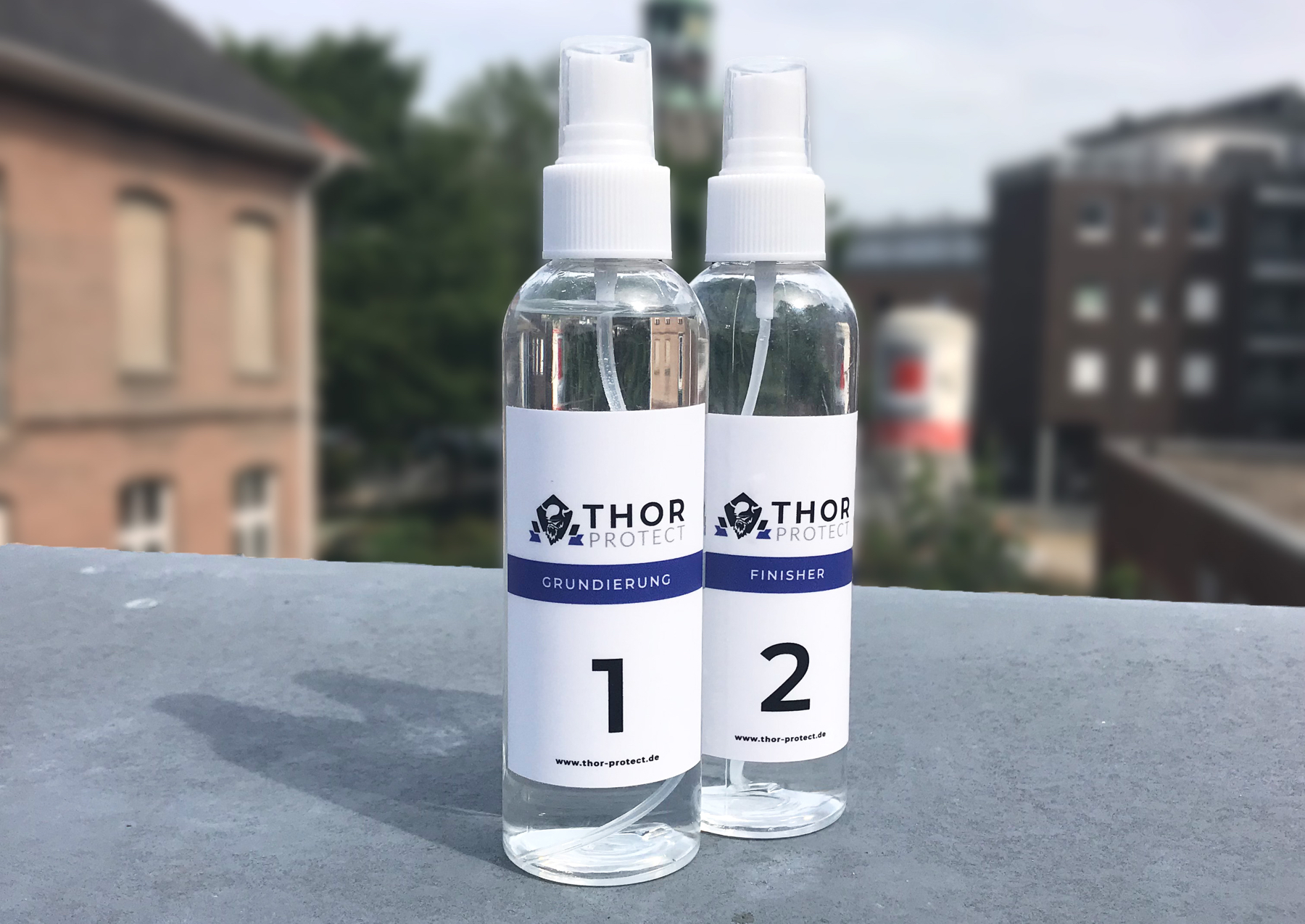
What issue does your wall have?
Option 1 – Mineral surface, penetrating damp: stone, concrete, masonry, and cement and lime plaster are among the listed substrates. Once the specific case has been clarified and the surface appropriately prepared, the Thor-Protect application can be planned.
Option 2 – Cold wall or suspected condensation: do not buy the Base Kit solely because of a damp patch. The available documentation does not substantiate an effect against condensation or thermal bridges for this system. First clarify the cause and appropriate measure.
Option 3 – Wall construction or cause unknown: gather information on the affected area, existing surface and how the problem has developed so far. A photo alone does not provide a reliable diagnosis. Use application advice to select the product, and have unclear causes of damage assessed by a professional.
The room is listed – the substrate decides
Living rooms and bedrooms: the manufacturer’s documentation lists both areas. Nevertheless, check the specific wall; the room’s name does not imply suitability for every plaster or existing coating.
Kitchen and bathroom: these rooms are also listed as application areas. This listing is not a promise to eliminate all causes of damp in the room. Product selection remains tied to the suitable mineral surface.
Children’s rooms: the manufacturer’s application information also includes this room. This does not constitute approval to apply the products in the presence of children. Primer and finisher must remain out of their reach; protective measures must be observed.
The material, cause and execution determine the decision, not the room’s name. No product effect on high indoor humidity is promised here.
Check what lies beneath wallpaper and paint
For application, the suitable mineral surface must be accessible and absorbent. Wallpaper, loose layers and barrier-forming coatings must be removed according to the instructions. An existing surface is therefore not automatically a suitable substrate.
For cement or lime plaster, check the condition and preparation. Gypsum plaster must not be treated as approved plaster that can remain in place. For plasterboard or an unknown wall construction, the application must be clarified beforehand.
Avoid ordering on the assumption that all interior walls are the same. Note the wall’s building material and the layers on top of it. Use the existing application instructions for preparation – not a simplified set of instructions for all surfaces.
Prepare not just the wall, but also the work area
According to the safety data sheets, Primer No. 1 and Finisher No. 2 irritate the skin and eyes. Use the prescribed protective equipment and observe the safety instructions for both components. Keep the products away from children.
Protect adjacent sensitive surfaces from splashes. The instructions list glass and aluminium profiles, among others. Plan access to the wall and protection of these surfaces before application.
Listing a room is not proof of health safety and does not establish a particular period after which it can be used again. Resolve outstanding questions about application and subsequent use based on the current product documentation.
Before application, open the safety data sheets and the instructions supplied with your kit. A product photo or a general brief description is no substitute for this documentation.
From a clarified application to the right material
Small, suitable job or limited test: check the 1 m² Test Kit. According to the instructions, it contains test material for approximately 1 m². A small complete job is suitable only if the required margins and material absorption have also been taken into account.
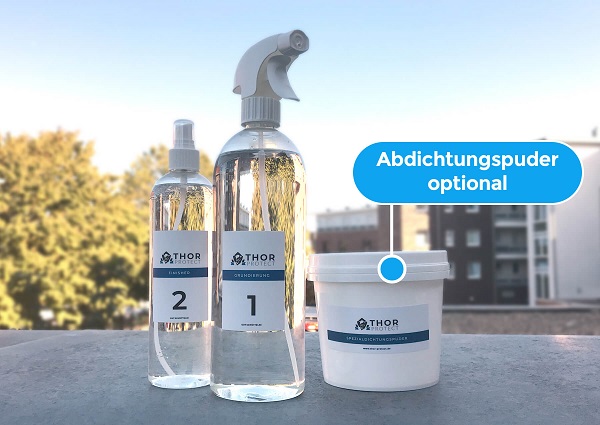
Larger agreed treatment area: open the Base Kit and choose the available quantity according to your plan. There is no reason to buy a larger package solely because of the room’s name.
Order for the actual treatment area. The existing documentation specifies different margin widths; clarify the specific execution rather than equating the visible patch with the material coverage.
You can see prices, available quantities and current contents on the product page. If the construction or cause is still unclear, seek advice first rather than buying on a hunch.
Plan the work in a sensible sequence
1. Clarify suitability. Describe the substrate and existing layers. Distinguish penetrating damp from an unclear or condensation-related situation before selecting the system.
2. Prepare the area and protection. Define the treatment area, including the agreed margins. Prepare the accessible mineral surface and the work area according to the instructions.
3. Apply according to the kit. Use primer and finisher according to the current instructions for your kit. Do not take the number of applications or waiting times from other kit instructions; no blanket completion deadline for further work is given here.
Explore the right question in more depth – not another general guide
Understand the causes: the existing guide to damp basement walls shows why observations and causes must be distinguished. Its focus remains the basement; it is not a remote diagnosis of your living-space wall.
Prepare for application: for practical application, the existing sections on application and safety data sheets provide further information. This keeps instructions and safety information in their existing locations rather than describing them again here with contradictions.
Visible mould: treat the infestation and cause of the damp as separate issues. Listing living spaces as an application area does not imply general mould-removal approval for primer and finisher. Clarify the approach separately.
Frequently asked questions
Does Thor Protect reduce humidity in living spaces?
This page does not promise to dehumidify indoor air. The documented application listing concerns suitable mineral surfaces affected by penetrating damp. For high humidity and condensation, the appropriate measure must be clarified separately.
Can Thor Protect be used in a bedroom?
Bedrooms are listed in the manufacturer's documentation. Nevertheless, the suitable mineral substrate, cause of the damp and safe application are the deciding factors. The listing is neither proof of emissions performance nor approval for application while people are present.
Is application on plasterboard approved?
General waterproofing approval for plasterboard cannot be inferred from the documentation evaluated. Gypsum plaster is also expressly excluded from the plasters that may remain in place. Clarify the wall construction and approach before ordering.
Can I simply leave wallpaper and wall paint in place?
Not as a general rule. The suitable mineral surface must be accessible and absorbent. Wallpaper and loose or barrier-forming layers must be removed according to the instructions; the specific construction determines the preparation.
When can the room be used again after application?
The available documentation does not establish a universally applicable period after which the room can be used again. Observe the current kit-specific instructions and safety data sheets. Clarify use after application in advance rather than inferring approval from the smell or appearance of the surface.
Which package do I need for a small patch in a living space?
First, the application must be suitable. The treatment area including margins and material absorption then determine the quantity. The Test Kit is described as covering approximately 1 m²; it is neither automatically sufficient for a visible 1 m² patch nor necessarily just a preliminary step towards a larger kit.
Relevant information for your project
Take the next step
Bring clarity to your wall treatment. Have details of the material, existing layers and affected area ready. Clarify suitability – then buy the right material.